
Artist and Wife
Elisabeth Hudtwalcker (1752 – 1804)
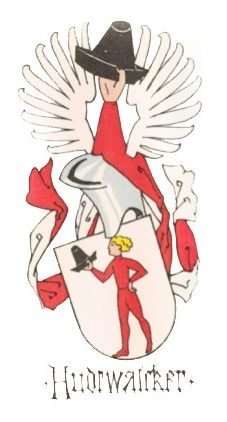
Ohlsdorf Cemetery, Grave: W 21, 64–84. Grave of a prominent person. Grave monument worthy of preservation.
“She was—and may this tear that falls upon these pages honour her—and since her life can no longer teach us, may her death teach us instead. What I have written about her was drawn with a trembling hand. May it be portrayed with the gentleness befitting the original. It is not intended to depict an extraordinary woman, but one whose life can teach us to what a high degree of virtue and joy life may be elevated even here. Proud that she was mine, may these pages testify that I knew how to appreciate her; and may they bear witness to how I loved her,” wrote the Hamburg merchant and later senator Johann Michael Hudtwalcker in his biography of his wife Elisabeth, whom he affectionately called Betchen.
Elisabeth was the youngest of three children born to the Hamburg citizen Vincent Moller and his wife Hedwig, née Thuun. The family lived in Höxter. Two years after Elisabeth’s birth, her father died of consumption at the age of 31. Hedwig Moller, a “remarkable and, for her age, highly educated woman,” raised her children alone. Elisabeth received instructions in music and painting. She was not, however, taught languages. She learned these only by sitting in a corner of the classroom and knitting while her brother received lessons in French and Latin. According to Johann Michael, Elisabeth Moller possessed “genius” and was “cultivated in every respect.”
She was acquainted with his sisters, and it was through them that the two came to know each other. “She was beautiful—perhaps only to me,” mused Johann Michael Hudtwalcker. He fell in love with Elisabeth and showed considerable imagination in doing so. He had a fictitious letter placed in the newspaper in which a young girl made allusions that only Elisabeth Moller could understand. Elisabeth knew what Johann Michael meant by this—and there was nothing more standing in the way of their marriage.
Johann Michael Hudtwalcker’s parents welcomed Elisabeth warmly, as she came from a family of appropriate social standing. They were, however, somewhat concerned about her frail health, as Elisabeth had suffered from severe toothache for years. After a doctor had issued a “favourable” medical report, however, the wedding could go ahead. The 22-year-old Elisabeth Moller and the 27-year-old Johann Michael Hudtwalcker were married on 21 June 1775 and lived in the family home at Katharinenstraße 83.
Married, but not yet a mother, Elisabeth was still able to devote her leisure hours to painting. She copied paintings in chalk and learned to draw from nature. On country excursions and at social gatherings, she always carried a sketchbook with her. Her favourite activity, however, was portraiture. She presented her brother-in-law, who was conducting business in Livorno, with a collection of portraits of the Hudtwalcker family, drawn in white chalk on a blue background. But she was never satisfied with her drawing skills.
A year after the wedding, Elisabeth became pregnant. “But now she lost courage—or rather, she found the courage to undertake a higher calling. She felt inspired by it. She was more a mother than an artist. She would gladly have exchanged the reward that might have been carved for her in bronze for the smile of a child,” Johann Michael Hudtwalcker wrote of his deceased wife. She herself confirmed this. For her, «the fulfilment of a mother’s duty offered a greater reward than the spendour with which glorious deeds must content themselves.»
Elisabeth Hudtwalcker read Rousseau and Basedow in preparation for raising her children. On 4 August 1776, her first daughter, Hedwig Sara Elisabeth (1776 – 1812), was born. According to Johann Michael Hudtwalcker, her second child, Amalia Thusnelda (1778 – 1779), was born eleven months later. However, a family tree compiled at a later date gives the date of birth of the second daughter as 6 March 1778, approximately a year and a half later. It was a great loss for Elisabeth when her second daughter died at the tender age of ten monhths, on 18 January 1779, from complications associated with teething.
Following the birth of their first son, Jacob Hinrich (1753 – 1799), on 30 May 1779, Elisabeth and Johann Michael Hudtwalcker decided to have their children vaccinated against smallpox. The vaccination, however, caused significant complications for their daughter Hedwig. She developed an eye disease that would persist for years. Elisabeth devoted herself tirelessly to caring for her daughter – as she did for each of her children. Two years after Jacob Hinrichs birth, their son Hermann (1781 – 1826) was bor non 28 May 1781, followed the following year, on 27 November 1782, by Carl (1782 – 1854). Elisabeth now had a large household to manage, with four children. Very frugally, orderly, and with a modest degree of apprehension, she set about her responsibilities. Before long, however, she had organised the household so efficiently that she “only” had to supervise the staff.
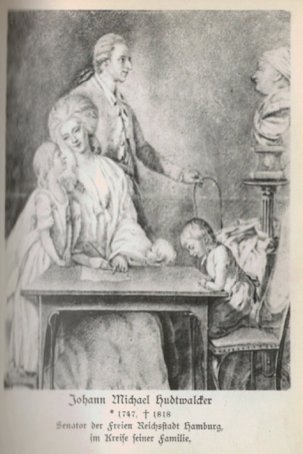
Now her old desire to paint began to stir again. Elisabeth took every opportunity to do so. Yet even though she had her household under control, it demanded so much work from her that she could often pursue her painting only by getting up early. Because she had to expect constant interruptions while painting in order not to neglect her duties as mother and housewife, Elisabeth increasingly stopped working in oils. She received instruction from a Madame Marthes in the use of watercolours. One of her most accomplished works is a drawing of her six children. Yet again and again, her painting conflicted with her work as a housewife and mother. She was constantly caught in this dilemma. And so, her husband writes, she “soon began to realise that her circumstances and higher duties did not permit her to follow her inclination. The life of a woman in Hamburg who is both mother and housewife, and who neither can nor may withdraw from the society in which it is also her calling to live, conflicts too greatly with the true life of an artist, … so that she did not throw away the easel, but resignedly set it aside until quieter times—which, however, never came to her.” Her domestic duties allowed her only to draw, for example with black chalk on white paper. She mostly portrayed her friends, preferably women, as she found female faces more difficult to draw.
Four more children were born: Thusnelda (1784 – 1866), born on 7 August 1784; Ernst (1786 – 1823), born on 1 February 1786; and Caroline (1787 – 1787), born on 18 July 1787. Caroline lived for only eighteen days and died on 4 August 1787. On 14 July 1789, at the age of 37, Elisabeth gave birth to her last child – a daughter named Ernestine (1789 -1790). She lived for only ten months, however, and die don 6 May 1790, like her second daughter, from complications associated with teething.
Illness and misfortune continued to accompany Elisabeth throughout her life. Shortly after her husband was appointed senator in 1788, Elisabeth fell ill with inflammatory fever. As a convalescent holiday, Elisabeth and Johann Michael travelled through Holstein with their eldest children. Soon after the journey, however, the children contracted measles.
They undertook another journey in an attempt to find some consolation after the painful loss of their last child. The journey took them via Leipzig, Dresden and Freiberg to Berlin. After six weeks, the family returned to Hamburg via Braunschweig and Wolfenbüttel. During the journey, the Hudtwalckers visited friends and met with artists such as Schadow, Zingg, Oeser, Graff and Chodowiecki, from whom Elisabeth received encouragement for her work. In every city, Elisabeth visited the art galleries. Until completely exhausted, she studied the paintings in the galleries of Dresden and Berlin, works that far exceeded her expectations. And yet Elisabeth noted in her travel diary:
“What is art compared with nature! The former, after much arduous labour, soon moves towards its own ruin; the latter, with only a little care, becomes more magnificent day by day, brings health and joy, ever greater and more cheerful enjoyment, and draws us closer to our Creator.”
During the journey, Elisabeth’s frail constitution increasingly began to trouble her. She reached her physical limits very quickly, resulting in frequent fainting spells. Nevertheless, the journey brought Elisabeth great happiness. Her greatest joy lay in finding people with whom she felt a connection and with whom she could build friendships, and on this journey she found many friends.
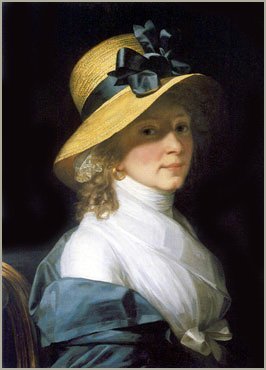
Elisabeth suffered a third bout of inflammatory fever and, after seven days of illness, died surrounded by her family on 22 November 1804. Shortly before her death, she was still able to witness the recovery of her eldest daughter from her eye disease. A portrait of Elisabeth Hudtwalcker, painted by Jean Laurent Mosnier, now hangs in the Hamburger Kunsthalle.
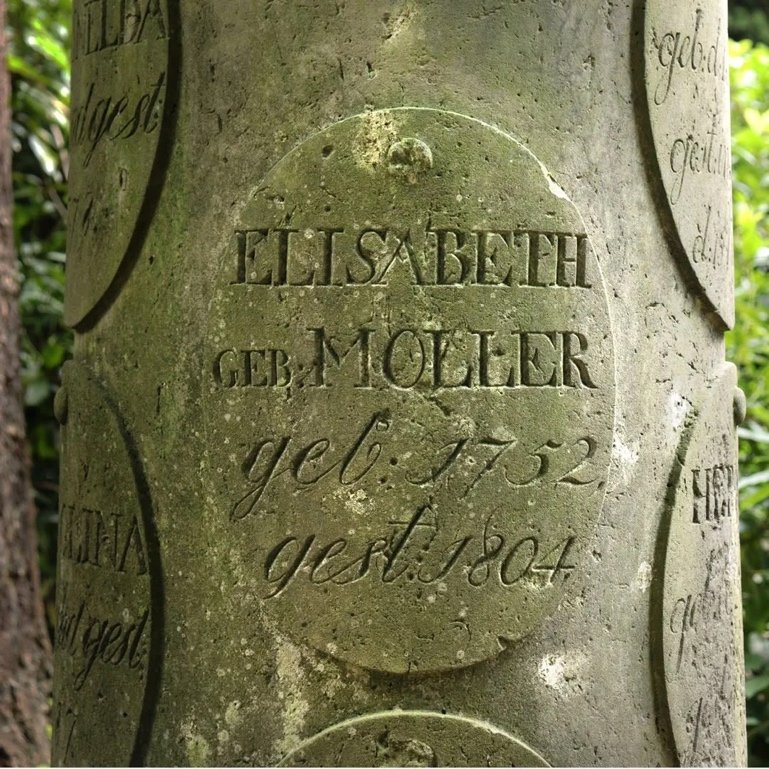
Her grave is marked by a column with a flat, conical capstone; one side of the column bears oval inscription panels, while the other has recessed lettering of names. Beneath the capstone is the inscription:
“Forms come into being and fade away;
life must face decay,
and the ray return to its source.”

Text
Anke Schultz
Sources
Staatsarchiv Hamburg: Fa. Beneke. Quoted in: Anne-Charlott Trepp, “‘Denn da ist gerade meine Wonne …, daß du mich wie ein kluges, denkendes Wesen behandelst’: Frauen und Männer im Hamburger Bürgertum zwischen 1770 und 1840 – Fragestellungen und Ergebnisse.” In: Hamburger Arbeitskreis für Regionalgeschichte. Mitteilungen 29, November 1996.
© 2025 Garten der Frauen e.V.
www.hudtwalcker.com 2026